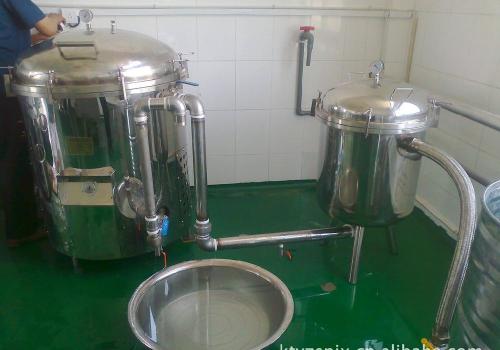
The filter bed is a set of filters that operate continuously, filtering dirty oil under pressure through side filtration. It consists of a series of filter plates and filter frames arranged alternately in sequence, along with a mechanism including a manual screw pressing device and a pressing plate. The sides of the filter plates and frames have "ears" that support them on the machine frame's support plates. Between the filter plates and frames, filter paper (or filter cloth) is used as the filtering medium. Through the pressure of the pressing device, the filter plates and frames are pressed between a fixed thrust plate and a movable plate, forming individual filter chambers. The filter paper (or filter cloth) pressed between the filter plates and frames performs the filtering action. Two liquid passage holes are provided at corresponding positions on the filter plates and frames, which, when pressed together, form two complete channels. The triangular side of the ears introduces dirty oil, which, after passing through the filter chambers, exits as clean oil from the corresponding channel on the fan-shaped side of the ears. During filtration, dirty oil is distributed through the inlet channel to each filter frame, passes through the filter paper into the liquid passage holes of the filter plates, and the clean oil is collected in the outlet channel and discharged from the machine. Impurities remain on the surface of the filter paper, and a small amount of water in the dirty oil is absorbed by the capillaries in the filter paper. As the filter cake on the filter paper surface gradually thickens and the moisture content in the filter paper increases, the filtration resistance increases. When it reaches a certain level (generally 0.2 to 0.35 MPa), filtration should be stopped, and after replacing the filter paper, continue use.
The gear pump is connected to the motor with an elastic rubber pad. To prevent mechanical accidents caused by excessive pressure, a safety valve is installed at the lower part of the oil pump (it has been adjusted to the specified maximum pressure value at the factory). According to user needs, the safety valve can be set to a lower value, but it is not allowed to adjust it beyond the specified maximum pressure value.
The oil pump and motor are installed below the filtration part, and the liquid output by the oil pump is delivered to the filtration part through the discharge pipe and thrust plate. The gear pump gears are supported by rolling bearings and are lubricated by the oil pumped by the pump itself. The coarse filter is installed at the suction end of the oil pump to prevent large particles from entering and damaging the pump. When the bolts on the coarse filter cover are loosened and the cover is removed, the filter screen can be directly taken out for cleaning, because if the coarse filter is full of dirt, it not only rapidly reduces the oil filtration capacity but may also damage the filter screen. When there is oil in the tank, the return valve can be opened, to suck away the stored oil and prevent it from overflowing, and discharge it outside the machine.
The plate-and-frame oil filter machine has the advantages of simple structure, easy operation, and low operating costs.
Application Fields
The plate-and-frame oil filter machine is specially designed for power plants, substations, industrial and mining enterprises, lubricating oil warehouses, tractor stations, petroleum, chemical, metallurgy, national defense units, etc. It is mainly used to filter water and impurities from transformer oil, turbine oil, engine oil, diesel oil, aviation hydraulic oil, and other oils. It can also be made of stainless steel for filtering vegetable oil.