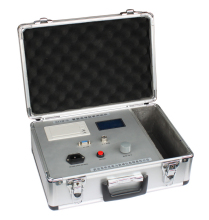
2.1. Measurement Range
Salt Density: 0.0000mg/cm2~ 9.9999mg/cm2 (based on X-4.5 insulator) Temperature: 0℃ ~ 50℃ Conductivity: 0 ~ 100000μs/cm
2.2. Measurement Accuracy
Salt Density: Resolution 0.0001, full-scale accuracy better than ±2%
Temperature: Resolution 0.1, accuracy better than ±0.5℃
Conductivity: Resolution is 1/1000 of the electrode range used, full-scale accuracy ≤±2%
Instrument Maintenance and Care
The electrode of the salt density tester is composed of two platinum black-plated platinum sheets (platinum black electrode), with an electrode constant ranging from 0.80 to 1.20. The electrode head of the conductivity electrode is easily damaged. When measuring, be careful not to collide with the container to avoid damage. When measuring solutions with very low conductivity, use containers made of neutral glass, quartz, or plastic with low solubility. To prevent the platinum black electrode from becoming inert during use, it must be immersed in distilled water before and after use. Once the platinum black electrode is found to be inert, rinse it with distilled water or reconfigure the platinum black electrode.
Below 330 kV |
Below 220 kV |
Below 330 kV |
0 |
1.39 (1.60) |
1.45 (1.60) |
/ |
/ |
Ⅰ |
1.39-1.74
(1.60-2.00) |
1.45-1.82
(1.60-2.00) |
1.60
(1.84) |
1.60
(1.76) |
Ⅱ |
1.74-2.17
(2.00-2.50) |
1.82-2.27
(2.00-2.50) |
2.00
(2.30) |
2.00
(2.20) |
Ⅲ |
2.17-2.78
(2.50-3.20) |
2.27-2.91
(2.50-3.20) |
2.50
(2.88) |
2.50
(2.75) |
Ⅳ |
2.783.30
(3.20-3.80) |
2.91-3.45
(3.20-3.80) |
3.10
(3.57) |
3.10
(3.14) |
Note: 1) When calculating the creepage distance ratio for lines and power plants/substations, the maximum system operating voltage is used. The numbers in parentheses in the above table are calculated based on rated voltage.
2) When calculating the insulation strength under each pollution level, the geometric creepage distance is still used. Since the effective coefficient of insulator creepage distance needs to be determined based on a large number of artificial and natural pollution tests, it is currently difficult to list them one by one; see reference 3.
3) For power station equipment level 0 (creepage distance ratio of 1.48CM/KV for 220KV and below, and 1.55CM/KV for 330KV and above), it is currently retained as a transitional pollution level.
3. Suggestions for Salt Density Measurement of Equipment in Power Plants and Substations
There are various types of equipment operating in power plants and substations. A representative one is the rod-shaped post insulator. The salt density measurement method can be adopted as follows:
1) The sampling equipment for measuring salt density is a standard suspension insulator, while sampling for substation equipment should gradually transition to mainly post insulators. When measuring the salt density of small rod-type post insulators, in principle, the upper, middle, and lower sheds are measured, and the average value is taken. Each shed is from the lower edge of the upper shed to the upper edge of the next shed.
2) When measuring the salt density of other types of insulators in substations, the difference from ordinary rod-shaped post insulators should also be considered. For example, the salt density on the porcelain surface of a bushing with a large diameter is lower than that of a post insulator.
3) When determining the pollution level based on the salt density value measured on post insulators (sampled on ordinary post insulators), generally:
Pollution Level |
Ⅰ |
Ⅱ |
Ⅲ |
Ⅳ |
Salt Density (mg/cm²) |
≤0.02 |
0.02-0.05 |
0.05-0.1 |
0.1-0.2 |
Note: Level 0 salt density is less than 0.02