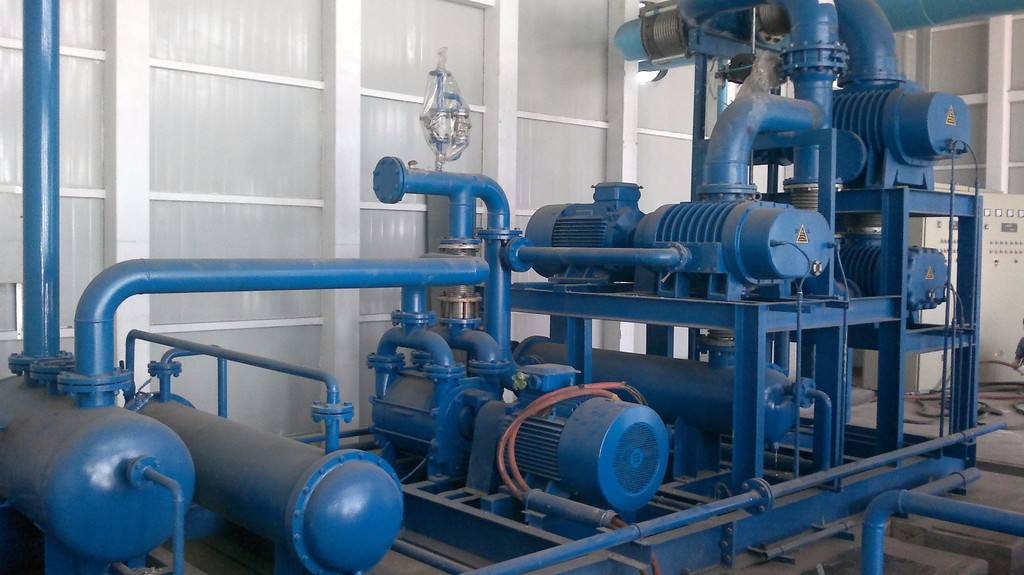
Factors Affecting Vacuum Pumps
1. Research on working steam and its dryness:
Low steam pressure and pressure fluctuations have a significant impact on the capacity of the vacuum pump. Therefore, the steam pressure should not be lower than the required working pressure. However, since the structural design of the vacuum pump is fixed, excessively increasing the steam pressure will not increase the pumping capacity or the vacuum degree. Additionally, it is essential to ensure that the steam pressure supplied by the boiler is stable. Ideally, a dedicated boiler should be used to provide working steam for the steam jet pump, so that the steam pressure does not fluctuate, ensuring stable performance of the vacuum pump.
2. Research on requirements for circulating cooling water:
If the cooling water supply is insufficient, the condenser will heat up, the airflow sound will become louder, the vacuum degree will drop rapidly, and steam may even flow back into the suction pipe. Condensate water plays a crucial role in multi-stage vacuum pumps. It can fully condense the steam. The partial pressure of water vapor in the discharge pressure of the vacuum pump must be higher than its corresponding saturated vapor pressure. Therefore, the temperature of the condensate water must also be lower than the saturation temperature at that pressure to ensure normal operation of the pump body.
3. Research on sealing requirements of the vacuum pump system:
When the vacuum pump is in the ultimate state, the first stage discharges very little water, sometimes even none. Therefore, if the first stage pump has a large amount of water discharge, it can be considered that there is leakage in the system. Common causes of air leakage include: gaskets not installed, installed incorrectly, or damaged; bolts not tightened; flange surfaces damaged; pinholes in welds; and connectors (such as pressure gauges, vacuum gauges) not properly installed.
4. Research on nozzle requirements:
The nozzle is an important component affecting the performance of the vacuum pump. Existing problems include: incorrect installation, misalignment, blockage, damage, corrosion, and leakage. Regardless of the preventive measures taken, nozzle blockage is inevitable. On one hand, when installing the steam pipeline, residual iron filings and welding slag in the pipeline can block the nozzle; on the other hand, when the vacuum pump system is out of service, the steam pipeline is prone to rust, and rust flakes can fall off and block the nozzle during use.
5. Influence of steam:
The commonly used vacuum pump is a steam jet vacuum pump, which uses superheated saturated steam as the working medium. The condition of the steam has a decisive influence on the pump's performance. Wet steam not only affects the pump's performance but also corrodes the steam nozzle, increases the steam consumption of the pump, and makes the pump's operating condition unstable.
6. Influence of environment:
The influence of the environment mainly refers to the contamination of the system by the pumped gas. During the steel liquid treatment process, the steel liquid releases a large amount of gas, and at the same time, some fine oxide powder particles and other small particles are sucked into the vacuum pump. These small particles will accumulate and adhere to the pump body, reducing the conductance of the suction pipeline, prolonging the pumping time, and decreasing the pump's pumping performance.
7. Influence of pump body layout:
For single-stage vacuum pumps, the part that is easily worn is the steam nozzle. After the nozzle is worn, it not only affects the pump's performance but also increases the operating cost of the system.
A vacuum pump refers to a device or equipment that uses mechanical, physical, chemical, or physicochemical methods to evacuate air from a sealed container to obtain a vacuum. In simple terms, a vacuum pump is a device that improves, generates, and maintains a vacuum in a closed space using various methods.
According to the working principle of vacuum pumps, they can basically be divided into two types: gas capture pumps and gas transfer pumps. They are widely used in industries such as metallurgy, chemical, food, and electronic coating.