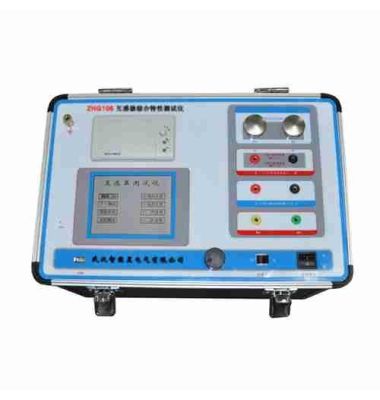
A transformer partial discharge tester is an important tool used to detect partial discharge phenomena inside power transformers. Partial discharge is a localized arc discharge phenomenon caused by design flaws, manufacturing defects, or other factors within the transformer's insulation system. This phenomenon gradually damages insulation materials and may eventually lead to transformer failure. Therefore, timely detection and handling of these issues are crucial for ensuring the safe operation of the power system.
Working Principle
Transformer partial discharge testers mainly use the following methods to detect partial discharge phenomena:
Pulse Current Method: Detects the presence and intensity of partial discharge by measuring the pulse current signals generated by partial discharge.
Ultrasonic Detection: Uses ultrasonic sensors to capture ultrasonic signals generated during partial discharge.
Transient Earth Voltage (TEV) Detection: Detects transient electromagnetic waves caused by partial discharge, especially earth voltage signals.
Optical Detection: Detects optical signals generated by partial discharge through spectral analysis and other means.
Main Structure and Components
Control Console: Used to control the entire testing process, including the operation of the voltage regulator and test transformer.
Voltage Regulator and Test Transformer: Generate the pre-applied voltage and test voltage required for testing.
Coupling Capacitor: Used to couple partial discharge signals from the high-voltage side to the measurement system.
Detection Impedance: Converts partial discharge signals into a form that is easy to measure.
Signal Processing Unit: Analyzes and processes the collected signals to identify partial discharge characteristics.
Display and Storage Unit: Displays test results and can save data for subsequent analysis.
Features
High Sensitivity: Can detect weak partial discharge signals.
Good Accuracy: Combines multiple detection methods to improve judgment accuracy.
High Safety: Design fully considers operator safety, such as ensuring safe distances between high-voltage parts and the instrument.
Multifunctionality: Modern testers typically integrate multiple detection methods to adapt to different testing needs.
Ease of Operation: User-friendly interface and simple operation.
Application Fields
Power Transformers: Used to detect insulation defects inside transformers.
High-Voltage Switchgear: Detects partial discharge phenomena inside switchgear.
GIS (Gas-Insulated Switchgear): Used to detect partial discharge inside GIS.
Cable Systems: Detects partial discharge in cables and their accessories.
Development Trends
With continuous technological advancement, transformer partial discharge testers are developing in the following directions:
Intelligence: Integrating advanced data analysis algorithms to automatically identify partial discharge types and severity.
Miniaturization and Portability: Designing smaller and lighter equipment for convenient on-site testing.
Wireless Communication: Supporting wireless data transmission to improve operational convenience.
Multi-Parameter Fusion: Integrating multiple detection methods to enhance diagnostic comprehensiveness and accuracy.
Remote Monitoring: Enabling remote data collection and monitoring via the internet for real-time tracking of equipment status.
Conclusion
As an indispensable detection tool in the power system, the transformer partial discharge tester plays a vital role in preventing and reducing power equipment failures. With technological progress, future testers will become more intelligent and convenient, providing stronger support for the safe and stable operation of the power system.