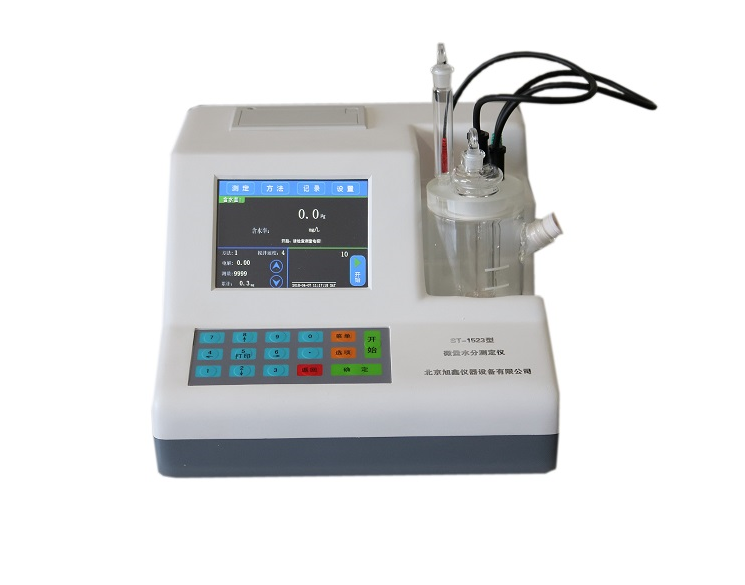
Why the Trace Moisture Analyzer Has High Measurement Accuracy
The trace moisture analyzer, abbreviated as micro moisture meter, mainly adopts the classic theory — Karl Fischer micro-coulomb电量法; based on the electrolysis law, the number of water molecules reacting is proportional to the charge number, and the instrument detects the number of charges participating in the reaction (coulombs) and automatically converts them into corresponding water molecules. Therefore, this method has extremely high testing accuracy and extremely low testing cost, and has advantages that other testing methods cannot replace. The instrument displays the measuring electrode signal in bar graph form, intuitively indicating the water content of the electrolyte, and depicts the curve of electrolysis speed versus time in real time.
Detectable substance types include: gasoline, hydraulic oil, insulating oil, transformer oil, turbine oil, fire-resistant oil, as well as various alkanes, benzenes, olefins, phenols, ethers, alcohols, esters, and other chemical elements. It is widely applicable in fields such as petroleum, chemical industry, electric power, pharmaceuticals, commodity inspection, scientific research, and environmental protection.
In terms of instrument design, it adopts constant current electrolysis technology to reduce overall power consumption; displays the measuring electrode signal in bar graph form, intuitively indicating the water content of the electrolyte, and has electrode open circuit and short circuit self-check alarm functions. It implements protection functions in screen saver to extend the service life of the LCD. The overall use is very simple, easy to get started, and convenient for consumers.
The above is a brief introduction to the trace moisture analyzer. As for why the testing accuracy is so high and sensitivity so good, partly thanks to the manufacturer not cutting corners in design and production, and not using unqualified components, the main reason is that it adopts the Karl Fischer micro-coulomb电量法.