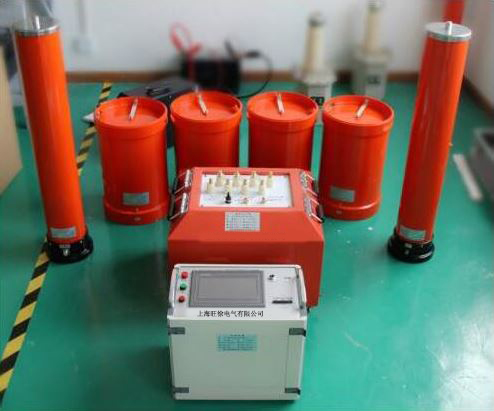
Series Resonance Test Device (Frequency series resonance device) is a series resonance test device that uses a tuned inductor and load capacitance to produce power frequency series resonance, thereby obtaining a power frequency test voltage. The series resonance consists of an isolation transformer, a frequency and voltage regulating power supply, an excitation transformer, a reactor, and a capacitive voltage divider. The capacitance of the test object and the reactor form a series resonance connection; the voltage divider is connected in parallel with the test object to measure the resonance voltage on the test object and serve as an overvoltage protection signal; the frequency-modulated power output is coupled to the series resonance circuit through the excitation transformer, providing the excitation power for series resonance.
AC withstand voltage tests for various large power transformers, power cables, steam and hydro generators, and other capacitive equipment must be conducted regularly in strict accordance with test procedures. Under power frequency conditions, due to the large capacitance of the test object or the high test voltage requirements, the power capacity of the test device also has correspondingly high requirements. Traditional power frequency withstand voltage devices often have large single-unit volume, heavy weight, are inconvenient for on-site handling, and are not easy to combine arbitrarily, resulting in poor flexibility. A better method is to use the series resonance method for withstand voltage tests.
The variable frequency series resonance test device is different from general-purpose test instruments. Its biggest feature is that the same set of equipment can be used for AC withstand voltage tests of different electrical equipment, such as cross-linked cables, transformers, GIS, motors, and generators. In addition to the series of typical commonly used models provided in this selection catalog for users to choose from, it is usually necessary to design a configuration scheme based on the user's test object range and test requirements, to meet the test requirements of different regions, different users, and different test objects.
Product Features:
1. The device has protection functions such as overvoltage, overcurrent, zero-position start, and system detuning (flashover). The overvoltage and overcurrent protection values can be set according to user needs. When the test object flashes over, the flashover protection operates and can record the flashover voltage value for test analysis.
2. It is controlled by an embedded touch screen internally, with optimized operation functions and simple operation.
3. The device has three working modes, allowing users to flexibly choose according to on-site conditions and improve test speed. The working modes are: fully automatic mode, manual mode, and automatic tuning with manual boosting mode.
4. It can store and remotely print data. The stored data numbers are numeric, making it convenient for users to identify and search.
5. When the device automatically sweeps frequency, the starting frequency can be set arbitrarily within a specified range, and the sweep direction can be selected upward or downward. At the same time, the large LCD screen displays the sweep curve, allowing users to intuitively understand whether the resonance point has been found.
6. It adopts DSP platform technology, which makes it convenient to add or upgrade functions according to user needs, and also makes the human-machine interface more user-friendly.